Harvest Home at Rivendell

Well! It’s been a minute since May.

We’re still here, friends – upright, and if not in our right minds, at least close?

(Oh, hush – as close as we get. You know what we mean.) It’s been a gloriously healing summer. Leaving Casa de Depression was the best move, ever, even if we weren’t quite sure that we should. It’s been great, though – not having to create landscaping from nothing was relaxing. Casa Plácido has quite a yard – a weird yard, but we only seem to DO weird yards. This one is a full third acre… on a 40% grade. The ground cover is mostly rosemary bushes gone wild, and the owners, a couple who live in Barcelona, stuffed every fruit tree they could into the ground before we left. Fig trees? We got two. Olive trees? Four. Apple, Bartlett pear, Asian pear, persimmons, plum, mulberry, cherry, lemon, and grape vines, blueberry bushes? Er… yes. This is not to mention the five sequoias, fourteen rose bushes, and bougainvilleas, geraniums, lantana, hibiscus, and the narrow strip of lawn. It is, obviously, pure chaos. But, it’s the kind of chaos we can get behind, the kind of chaos which makes you shake your head in bemusement, laugh, and feel like a tiny corner of the world is good.


At least it’s the sort of chaos that has allowed us to make friends easily. We’ve enjoyed singing off and on with a large Presbyterian choir in Livermore since 2017, and now that we have joined them full-time, we’ve certainly cemented our welcome. People ask us wonderingly if we have a farm, as we returned in September bringing baskets of pears and bags of apples to share. Nowadays we get random texts of unidentified apple pies, and pots of apple sauce. It gives us a good feeling of community – something we’re relearning how to build. I don’t think people realize how gradually they withdraw from the world when stuff is falling apart. It was somewhat necessary, as it took all our energy to meet deadlines and work expectations, so it felt like we needed extra rest, but now that we’re beginning to feel better, it feels like we let a lot of things just… go. It’s a slow road back from that, but we’re getting there.

We spent a lot of time doing only what was necessary, and put off a lot of care we needed to do when Himself was a consultant. Being employed by a global company means we’re taking advantage of them providing health care (for however long that may last), and finding specialists. T. has finally gotten another rheumatologist, and D. a neurologist to address the familial inheritances he’s been given, and both of us have visited the physical therapist. All of that medical tuning up has coincided with an exciting summer of Disorders We Couldn’t Have Predicted. T’s latest one they believe is MEWDS – which stands for Multiple Evanescent White Dot Syndrome. It’s a delightfully descriptive name and an annoying optic nerve inflammation, leaving her with huge floaters and coruscating bright flashes which have occluded her sight in one eye. For someone who makes a living on screens and writing, that has been rather terrifying, but one of the reasons we moved into this house was that we knew that T’s medical issues aren’t going to clear up. A home with a beautiful yard and peace was a gift we could give to ourselves. Room for our people to visit whilst T might need to lay low is also a benefit.

On the professional front, D’s work at his new company is going well. While the state of discourse on artificial intelligence reaches a fever pitch, the company he works for has used it since the 80’s for necessary but boring things like modeling traffic patterns. It takes a certain kind of brain to be able to communicate well with computer “intelligence,” and Himself is so far fairly adept at it, and is finally, slowly, losing the feeling that he doesn’t know what he’s doing, and that everything is going to blow up shortly. Occasionally he goes in to the office, but is grateful to conduct most of his work online, as his boss is in another state, and some of his clients are in another country. Working from home is still a blessing we won’t ever take for granted.

Meanwhile T has had her eleventh book release and her fifth with HarperCollins this past week. We were happy to see its cover represented on the cover of the American Library Association’s Booklist magazine for September. One can’t buy that kind of free publicity, and even though her book was merely featured because of its color and a Valentine (being ripped in half – the issue contains a feature on romances, which her book is not, but …close enough?) she’s hopeful that it has been put before a few more librarian and bookseller eyes. Though she’s still a fairly quiet author, her books are steadily gaining wider regard. This past year saw two international publications licensed – one to France, and one to Romania, of all places. As T’s long-time agent (since 2005!) is now retiring as of her book release last week, she’s beginning the tedious process of finding a new one, feeling rather like she’s starting over on the dating scene – to which she says “Ugh.” It’s a good thing, though – new blood will catalyze new perspectives, at least in theory. All that newness will certainly give the desired neural plasticity a fighting chance, right? Right. There’s nothing like chaos to keep the brain young. Or something.

Speaking of chaos… yes, there’s much going on in the world outside our doors, beyond the “last homely house East of the Sea,” as J.R.R. Tolkien described it when he wrote The Hobbit. Once you walked past that house, things in the realm became Wild, and the world outside the Shire was unkind. We’ve always liked the thought of our own home as a bastion against the unkind world – and God knows what’s out there, especially lately, is painfully, irrevocably, and horrifically unkind. We hope our return to writing here – intermittent though it will still likely be – will give you a few brief moments of beauty as a fortress against this cruel and bombastic moment in our world.


Though there’s always something happening, and a lot of news to doomscroll, there’s also a time to close the paper, turn off the phone, and go outside. Don’t forget to appreciate the things that you have loved, and have voted to preserve. Don’t forget to hydrate, wash your hands, and touch grass. Reach out to friends. And remember, you are well-loved – may that fuel you to pass on an act of grace in return.

Happy Weekend


Summertime & the Living…

High summer, and we are among the living.

It’s it’s hard to believe how much has changed, when it seems that staying so close to home, so little does.

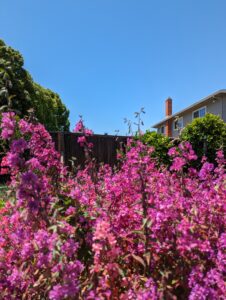
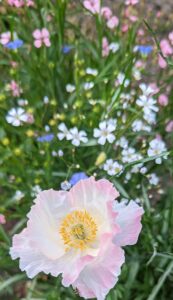
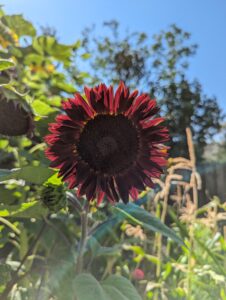
We took pictures of the yard when it was flat dirt, and when Himself was tilling and planting – but the pictures don’t do it justice. There’s nothing that can describe dead ground suddenly becoming alive… a sun-baked stretch of clay becoming a DIY meadow for dragonflies, butterflies, a league of lizards, two nesting pair of mockingbirds, a scrub jay, countless goldfinches and house finches and all the pollinators – at least three types of bees, by striping pattern, among numerous others, including tiny, jewel-green flies (whose ironic common usename is Green Jewel Flies. Can’t make this stuff up). Despite the clay soil and the fox leaving calling cards early on, somehow, this is the best garden, yet. We have giant zinnias. We have giant marigolds. We have …color and life and birds swooping around, and the odd tiny kestrel come calling, the ubiquitous crows, as well as the hooting of owls at night.

We are still here – and how are you?

We didn’t start out with the idea for a DIY meadow. We just knew we wanted… something to see. The entire back wall of the house is dedicated to windows, and we needed something other than flat ground and dirt to look at, as year turned. The extra rain we had this past winter really encouraged us to take a chance and drain the little pond that had settled itself into the center of the old fire pit – and T’s family giving her gardening supplies for her birthday in March sealed the deal. She received seeds she would have never otherwise purchased or tried growing. Just flinging the seed out there onto the newly tilled ground and hoping for the best made a big difference.

A study from the University of Colorado (funded by the American Cancer Society) published in January 2023 in the journal Lancet Planetary Health found that people who started gardening saw their stress and anxiety levels decrease significantly. This wasn’t WHY we started gardening, but it’s been a definite, positive by-product. This was a stressful winter workwise for Himself, with a lot of political shenanigans and nonsense going on. (Ironic that even working for yourself can be political.) Work hits its ebbs and flows, so there was less work with more annoying people. Odd how that works. T meanwhile slogged through finishing a novel that she didn’t want to write (but was under contract for). Dreading one’s work made it (at first) much harder work than she expected, and that took a lot out of her. And then, the health outcomes she was dreading came to pass – the new biologic drug she’s on showed wearying signs of not working, and, worse, brought on the hemolytic anemia she had carefully worked to prevent for years. Staggering with exhausting (and wishing that weren’t literal), depressed and discouraged after the long winter and uncertain Spring, both T&D needed a win.

Which was where gardening came in. Gardening, friends, is an act of faith.

One must believe in the potential of this weird looking bit of woody …something. It’s dull and tiny and one must toss it in the dirt like detritus, and think, “Okay, we’re told you have all that you need inside of you to do your thing. Go.” And then one must wait. Five to seven days, ten days, fifteen, and that woody bit of nothing …transforms. It pokes up through the soil, completely changed into the likeness of a plant – a tiny bit of green, which, in a few more days produces true leaves which determine what it will be. An act of faith, the substance of which is hoped for, the evidence which is now seen. To quote Audrey Hepburn, to plant a garden is to believe in tomorrow.

The pandemic zeitgeist invented something else called… rage gardening. People were so tired and fed up with things in the world that sometimes the only thing they felt like doing was hitting something… so they went out and hit the ground with a pick axe. (THIS is contraindicated – those suckers are heavy and you could hurt your back, and then you’d feel so much worse…Start with a hoe.) Ripping out plants, flinging away rocks and chunks of clay, yanking out weeds and sharply cutting a hoe into recalcitrant soil has continued to have its uses. Especially for T, for whom holding a hose to water some days requires sitting down, beating on something until she is breathless is helpful. There’s very little that individuals can do to change things, yet we are subtly shamed and castigated for the warming planet, for the political situation, for the stupidity of book bans. There is very little that is our fault, yet there is a lot which is our responsibility, and sometimes the very little we can do to control the depth of the handbasket in which we are going to hell wages war with the choices we can make to turn the lives of our community in a positive direction. Sometimes, life is exhausting. There is so little we control – but how many weeds are growing next to your zinnias? That, you can manage.

Obviously, not everyone gardens in a temper – that sounds exhausting, to say the least – but ripping out things and turning soil has left us understandably exhausted. At least that chronic fatigue makes sense. At least in the garden, frustration can be a source of good, to give us space to process what we know, that bad times won’t last forever, that we’re being cradled, held, and looked after, even when it doesn’t feel like it. That joy comes in the morning.

Gardening then becomes a portable magic. Carried from the parent plant, seeds, via bird poop, wind, rodent digestion, or some intrepid gardener who glares at the squirrels and frets at the finches stealing “his” seeds (sound like anyone you know? Maybe????), these bits of the future go out into the world, not knowing where they’ll land. But, land they do, and they recreate themselves, reinventing themselves to fit where they need to be, over and over and over again.

“It is a greater act of faith to plant a bulb than to plant a tree . . . to see in these wizened, colourless shapes the subtle curves of the Iris reticulata or the tight locks of the hyacinth.” –Claire Leighton, Four Hedges

Gardening allows us, even briefly, to take some of that mute, unseeing, seed-like faith into ourselves – and to wait steadily and patiently for what’s inbuilt to do its job – giving us space to wait with grace for in another day, a solution, a new medication, an ending to crisis.

We planted two types of melon this year – neither of them remotely “normal,” because seed catalogs arrive the day after Christmas, when it is dark and one’s resistance is at a low ebb. (Well played, seed companies.) T was enticed into purchasing two heirloom-ish things she’d never even heard of, one a single-serve Tigger melon, which begins a deep, striped green, but which is a deep, striped orange when ripe, and the other, a mastodon-sized, orange-fleshed monster.

The largest watermelon is about four to six pounds already, which we consider shocking – we’ve never successfully grown decent melons without “help” from the deer in the from of either stepping on each one of them, or taking a bite – one single bite – from each, because grazing animals are sometimes complete dorks. TBH, we’re afraid to hope the Tigger and the Orange Crush or whatever its called – actually come ripe. So far, however, they’re doing their thing, and sending out distinctive leaf-shapes on sturdy vines to colonize the shady area beneath the bushes along the fence.

Meanwhile, on the far side of the house we have at last count twelve Georgia Roasters – a Comanche Nation heirloom variety of squash used in the Three Sisters planting method (the squash, maize, and pole beans thing) – six or eight delicata squash, and a handful of birdhouse gourds ongoing. (Why we chose to plant those next to each other is a short, dumb story – we had old, old gourd seeds and didn’t think they’d germinate. Joke’s on us as both birdhouse gourds and roasters will grow a ten foot vine FROM ONE SEED. The morning glories are climbing them, and the vining is almost visible if you stand still watching them long enough. The race is on to pull down the neighbor’s fence).

The roaster squash, relatives of butternut, are just HUGE so far, and we’re not even close to their full weight, which sometimes exceeds fifteen pounds EACH, and they exceed the length of a forearm. We are excited to have overwintering hard squashes – something we’ve also not ever tried to grow. We also have birdhouse gourds going – we did those once and they were fun. We made all these cute birdhouses and gave them away — and the one we kept, a windstorm blew down and shattered, disappointingly. With the 35 mph winds we had last winter which blew down the fence we’re going to be much more careful with these.

The season is waning – we are collecting seeds and already seeing the fading of the intense colors and the drying out of the vines as the squashes and gourds begin to ripen. We have harvested and collected seeds ready to unleash into the soil to create another shorter, intense flowering season before the El Niño rains promised/threatened come and soggify the soil into unresponsive clay lumps again. We’re hopeful that the next growing season will be easier – that the green compost we turn into the sandy, clay soil will attract more worms and rejuvenate what tends to be basically worthless. We’ve had an amazing season without knowing what we were up against, and now plan to turn rice hulls and other organic material into the soil in hopes of helping it do even better.

Having access to an outdoor space is a privilege, one we’re aware of, and grateful for. Our world is smaller and circumscribed, and as you might expect, living with restrictions as we do, due to T’s autoimmune disorder, is sometimes annoying. The world leaves those chronically unable to participate behind, ever well-meaning but inadvertently too fast, and expecting everyone to keep up. We as a society don’t do well with protracted anything. With chronic illness, there’s almost this sense of “aren’t you done with that YET??? Nope, we’re not, and we might not be, for many years or ever. Happiness is dealing with what you can and letting the rest go, however. We haven’t contracted Covid, by the grace of God. We haven’t had more than a passing stomach bug – no serious illnesses other than the one(s) already here. Part of “the rest” that we’ve let go has been the things and people we expose experience firsthand, where we go and what we do. We hope to continue to make adjustments and figure out to live within our restrictions. We hope to hear how you’re doing. We hope someday things change. But, until then, there’s the garden – and the internet – and the blessings of friends who send good wishes, which we cannot take for granted.

Hold onto those things, and don’t let go.

The “Burn It All Down” Rant

First off – before we get going – Happy Summer! ’tis the season for salads, as the world continues to be tucked-in-the-devil’s-armpit temperatures. This is a really great savory salad addition. Enjoy!


Now for the rant – no, not that one. This is a new one:

We don’t often talk about accommodation in our family. Our sister JC uses a wheelchair, and when she got her first chair, T’s father ripped up all the carpet in the downstairs of the house, and tiled it. The pantry is no longer a narrow closet under the stairs but a wide space next to the fridge, with sliding barn doors. Things are at varied heights, and our sister’s closet in her bedroom has been rebuilt lower. None of this is an out-of-the-box solution T’s parents bought at The Disabled Store (if there’s any such thing, it’s ridiculously, prohibitively, SUPER expensive – like her wheelchairs). They just figured out some things, and made them work. It’s an evolving process.

Woodlands 14

We have learned, living with our sister, that casual ableism – subtle discrimination in favor of able-bodied people – is A Thing, an insidious thing, that exists. At her private, Christian elementary school she was carried around like a piece of furniture – or, more realistically, like a fondly disregarded cat or a rag doll, even though she was a child too old to be carried – and honestly, how safe was it for the school to allow other children to carry her? When she was older, she had to go up long inclines to even get to the wheelchair ramp. Our church was recently updated and modernized – and still lacks some basic ADA accommodation, including a ramp to the platform. Wheelchair users aren’t expected to actually, you know, be among the people giving the sermons or prayers, apparently. The family noted this, and basically accepted it in silence… because, what could we do? We’d asked a few questions to a few people, and gotten chagrined or blank-faced non-answers. Disabled people weren’t in the plans, and the plans would go forward as they were… because casual ableism Is A Thing. (NB: Some people feel we should have made more noise earlier. Probably. It’s hard to overcome conditioning when you’re in the minority, though.)

We almost expect organizations to fail JC, because they do it so often. When she went to beauty school, they put off her enrollment for a solid month because they were working on getting her a special cart at her height, a special chair for her clients, and specialized seating in her classroom basically panicking, honestly. She did get to go to Disneyland, and she got to go first on all the rides, which was A Really Good Experience, but even though they had time and means to prepare, she had to buy her own specialized equipment. Her beauty school sent people to wash her client’s hair for her… because they couldn’t figure out how to make the world work for a disabled stylist, regardless of what they promised when she enrolled.

Being diagnosed with an autoimmune disease in 2018 gave T more understanding and compassion about casual ableism than she’d previously had. When some days your hands don’t work to open jars in the kitchen, or carry heavy platters or a cast iron skillet… you have to make adjustments. When you can’t sit comfortably in every chair… you sit in your cushy chairs at home. You wear your mask everywhere, even though you hate it and would like to burn it with the heat of a thousand suns. You re-learn your life in a way that makes you hate yourself less for your shortcomings, you make allowances for the people who make assumptions, and who don’t understand… but you resent it with the heat of those same thousand suns, and those suns go nuclear over your baby sister.

Skyway Drive 132

So, when JC texted us six months ago, excited about attending her first concert at the Shoreline Amphitheater, we wished her eardrums luck, and didn’t think much of it… until she posted on Instagram that the venue was awful. “What happened?” asked. First, no one knew where the disabled parking lot was, and when they finally found it, they wouldn’t let her friends park there, even though they had a placard and a clear need. The parking lot was unpaved and difficult to navigate in a wheelchair. When they finally got in, finally found someone who knew where the ADA accommodating seats were, they discovered they had to go down a flight of eight stairs.

The woman on staff asked, “Can’t you walk down eight stairs?” and rolled her eyes when JC said she could not. And told her friends to “be quiet” when they protested this.

We aren’t the nice people in the family; that’s reserved for …somebody else, maybe T’s parents. What we’d like to do is focus the light of those thousand suns at the Shoreline with a giant magnifying glass… but we’re just offering advice as asked, and quietly seething and ranting on our blogs instead.

Some people just don’t get a break. They miss most of their senior year in high school because of surgery. They miss out on doing “normal” things with friends because they have to have friends whose cars are big enough for a wheelchair or who don’t mind breaking it down and putting it back together to get it in and out of a vehicle. They end up back on a kidney transplant list less than ten years after the first time. They’re in their twenties before they’re comfortable and confident enough to go to their first concert. It’s not fair, and while howling that into the stratosphere and a quarter won’t even get you a cup of coffee, we just had to say it out loud. With EVERYTHING ELSE horribly wrong in this country and this state and this world this week, this is icing-on-the-top of a bitter casual-ableism muffin of Not Fair, and we are going to do something about it.

Yeah, yeah, something without the sun and a magnifying glass. Probably.


x-posted@fiction, instead of lies

Remembering

Glasgow Cathedral T 12

If you visit Europe, I strongly encourage you to visit churches, and stately homes, and to keep your eyes out for the plaques. For the battle flags, torn to tatters. For the endless procession of names, each kept in its own place of honor, in the corner of a room, or on a memorial outside the village church.

I don’t think that we who have not served can have any sense of how truly devastating war is, and I really don’t think we as Americans can understand how terrible World War I was for Europe. By looking around, though, we can kind of get a sense for things, if we really take the time to contextualize the memorials.

Memorials are local, in the UK, in a way that they are not in the US. Here, war cemeteries tend to be where we encounter war memorials, if we encounter them at all. I remember there’s one in Concord CA, but that I only remarked it after we’d returned – it was simply part of the background, before. I believe there’s one on the waterfront in Vallejo, as well. But these are different to Scottish memorials, in that they’re general memorials. “We remember the men of…” sort of thing, and that’s about it.

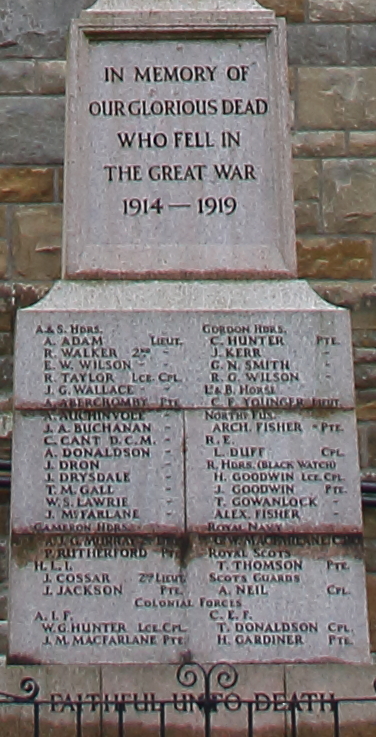
The memorials in Scotland were mostly very personal. “In memory of our glorious dead who fell in the great war 1914 – 1919,” followed by a list of 38 names. “Faithful unto death.”

Around Glasgow 503 HDR Cambusbarron 035 HDR
George’s Square, Glasgow
Cambusbarron Village Church

Some memorials are grand, meant to be the centerpiece, such as the one at the center of George’s Square, in Glasgow. Some stand forth to say, “our village gave dearly,” such as the one in front of the Cambusbarron village church; Cambusbarron was our home village for the last year we were in Scotland, so we got to walk past their monument any time we needed something from the village. Cambusbarron, at the height of its industrial vigor, housed a few thousand people and had a school capacity of 270. Cambusbarron volunteered 200 men to serve in World War 1, 38 of whom have names on the village memorial, as they (and a few others, unintentionally forgotten) never returned.

I don’t think I can really understand living with not only the sheer loss (1/5 of a whole generation of Cambusbarron died). I also don’t think I can possibly understand the trauma of having 1/5 of my generation absent forever, and the remainder of my generation would have seen them die. You see, quite a lot of villages joined up together, and were kept together, particularly in Scotland, where military service is a very … clan-centered activity. You join up with your mates, you join a particular regiment because that’s the regiment your village joins, and you go off to war. And then you spend the rest of your life walking past the ghosts of the dead every day on your way to the market.

Dunkeld Cathedral 68

Cambusbarron 002a

I remember my father becoming emotional about Veteran’s day, and not understanding why, not being able to conceive of why he – a true 1950’s man, for whom crying just didn’t happen – would be overwhelmed with sadness when the mood would hit him and he’d remember those lost in his own experience of war. From what I know, my father was not sent to Korea because he was in the Air National Guard (which wasn’t deployed). He was a pathologist in the Navy during the Vietnam war or shortly thereafter. But I don’t know why he cried, and it’s now too late to ask. Was it for classmates? There must have been lost classmates, considering my father attended Massanutten Military Academy. I simply do not know. And, of course, it’s not something he spoke of, at least not to me.

Veteran’s Day is not a day to celebrate America. It is not a day to celebrate America’s military might. It is not a day to beat the drums of war.

Veteran’s Day is a day to remember that war brings death, trauma, and generations of grief.

-D

Cheese Scones, Because…

One of the things we have left to us of our lives in Scotland is reading the Scottish papers. We still read the BBC News for Scotland, peruse The Herald, subscribe online to Bella Caladonia, and of course follow a number of Scots via social media. It’s always interesting to get a Scottish perspective on the world.

This week, however, the BBC reminded Scotland that it’s an English company, with a report most Scots saw as blatantly false. Scottish Twitter’s response to the various alarmist claims by English / Unionist media, about how the Scottish Nationalist Party is having a civil war, was swift. One would think the English would learn that the Scots will unite in the face of a common enemy…

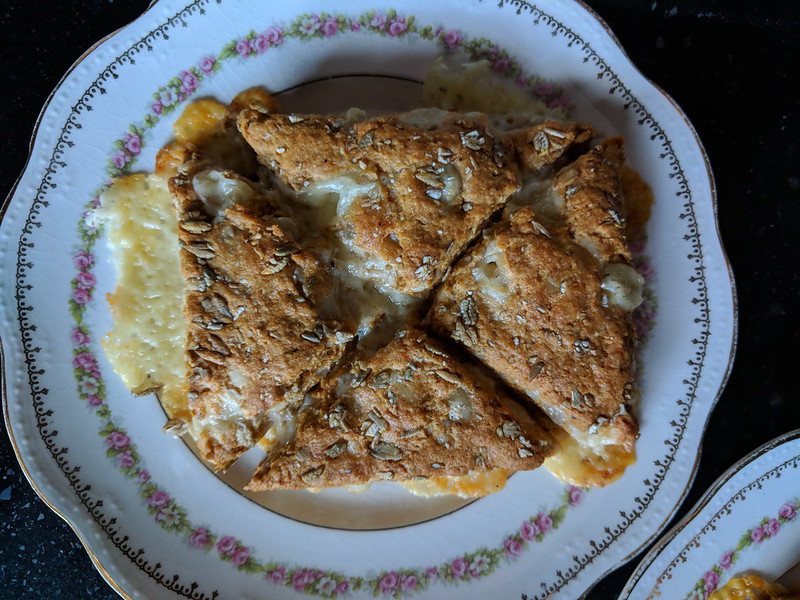
So, of course D. had to go make cheese scones (properly pronounced with a short ŏ, as in BOND) in support of our dear friends currently suffering beneath the staggering peril of so much sarcasm in one place.

Cheese Scones 11

-D & T

“There Are More Important Concerns.”

“Travel makes one modest – you see what a tiny place you occupy in the world” – Gustave Flaubert

Netherlands 2018 1071

Well, it was bound to happen. The first text message a week ago was just a little crack in the wall, as some eager beaver just had to tell D of exciting news from the office… and now today D has had to take a teleconference so that he can give his two cents on some whatever vendor tool for blah, blah, blah. The seal is broken, and the wall is crumbling. T is tallying the number of times D’s work mates have no boundaries and interrupt his well-earned and desperately needed vacation. She imagines kicking them smartly in the shins for each infraction.

(D worries when she gets on this topic, because he knows T, despite appearances to the contrary, is still somewhat feral and might actually tell them she’s imagined kicking them… while shifting her weight to one foot… But, we digress.)

Netherlands 2018 1034

Now that the vultures are circling and we can see the end of our trip just a few days down the pike, T has put on her junior sociologist’s hat and continued to process some of the things we’ve observed throughout our travels in this intriguing country (and from living in Scotland).

Twenty days in a country doesn’t exactly give scope for a deep dive into its society, but because we’ve lived abroad before, it’s easier to have a basis for comparison. Now, we’re fond of our home state and the benefits it has given us – and we love air conditioning, garbage disposals, public libraries and window screens — all things Europe commonly does not have. — BUT sometimes, American attitudes and ways of looking at things leave something to be desired.

Netherlands 2018 187

The interesting differences in attitude we’ve observed between countries is this idea of being The Best. The Netherlands is an amazing, brilliant country… and they don’t go on about it. In Scandinavia, there are national social mores about humility and modesty. The “best” is something perhaps children strive for; while adults, in contrast, just seem content to get on with things. Maybe it’s just that lately the national conversation has become steeped in empty superlatives – “greatest” “most” “best” – maybe it just seems like this blabbing about how awesome we are is new, but it’s not, really. To a certain extent, there’s always been an attitude of competitive striving – that “pursuit of happiness” which came from an adolescent nation determined to prove to a parental kingdom that it wasn’t just some rebellious kid going off on their own. We never intended to come crawling back to Mama England, and that bullheaded stubbornness has informed a lot of the flavor of our country. Ironically, those with the most privilege in this nation still struggle to recognize it because there’s a sense of deserving more, which causes so many a deep unhappiness — even as indigenous, Black, and people of color still haven’t yet achieved equality — but that’s clearly a topic for another blog post.

Netherlands 2018 163“Traveling is a brutality. It forces you to trust strangers and to lose sight of all that familiar comfort of home and friends. You are constantly off balance. Nothing is yours except the essential things — air, sleep, dreams, the sea, the sky — all things tending towards the eternal or what we imagine of it.” – Cesare Pavese

In contrast, in the Netherlands, there’s less an attitude of competition here than there is of normalcy. There is a phrase here about “just do the normal,” thus the word that crops up a lot in conversation is “typical Dutch x,” or “typical Dutch Y.” People believe that they are basically all about the same, and that “normal” is basically weird enough, and there’s no need to be seriously eccentric or try to stand out from the crowd… which flows right into another Netherlands phrase we’ve heard often on this trip, when the conversation has turned to deeper matters in terms of industry, religion, and politics: “There are more important concerns.”

Netherlands 2018 266

There are bigger stories; more important fish to fry. DB’s mother said it frequently, when speaking of religions reacting to gendering (churches are sluggish about inclusivity), or issues surrounding healthcare (she’s a physician). SC’s neighbor said it in passing when speaking of how the children in her daughter’s elementary school interacted. In almost every situation where our societal inclination would be to harp on a point or insist on clarification, explanation, or agreement, the reaction we’ve observed is for people to sit back and remark that there are more important things to worry about. Normal, after all, is weird enough.

This idea is kind of fascinating.

Netherlands 2018 698

We thought we understood about people kind of having a live-and-let-live attitude from living in the UK, but honestly, Scots are rather opinionated and are quite free with their opinions. (Just get into a cab once and have the driver tell you that you’re wasting his time and could have walked where you needed to go. THAT’s always fun when you’re lost.) We’re told that the Dutch are, too, but rather than air that opinion in an insistent way, apparently once they get to know you, they’ll simply put it out there and go on. If there’s disagreement, the opposing opinion is just put out there, and people go on. It’s not as if people don’t argue – but there has just seemed to be less of a competition for who has the last word. It’s interesting.

Maybe it’s that we’re still guests in all of the places we’ve been, and they’re just listening to us go on. Maybe they’re all secretly laughing at us. Who knows? Maybe there really are more important concerns, and they’re away getting on with them. And, so we will, too.

“Perhaps travel cannot prevent bigotry, but by demonstrating that all peoples cry, laugh, eat, worry, and die, it can introduce the idea that if we try and understand each other, we may even become friends.” – Maya Angelou

Netherlands 2018 730

Knowing When NOT to Work Hard

Last night I dreamed that I was called upon to give a lecture and I was unprepared. Apparently, though, I have some lectures that I give often enough that I’m able to pull one up on the fly, and my dreaming mind knows that I can always give the standard one I give to junior developers at some point: Be Intelligently Lazy.

Twenty-three years ago, I was working a full-time job doing data entry for a payroll processing company. This involved opening mailed-in timecards, “coding” them (sorting them into piles, basically), and entering their data into a Peoplesoft payroll system, with data entry done on Windows 3.1. After a couple months of doing this, I realized that I was typing the same thing over and over (each district manager had a markup rate, a name, a zip code, a phone number … and the fields probably went right in that order, actually), and it was incredibly boring and stupid, particularly when there was Windows Macro Recorder.

I set about assigning the 12 function keys to my 12 area managers’ information, typing in the information and tabbing through the entry fields as quickly as I could. When I was done and I’d written down which manager was on which key, I could type in the person’s name and their hours worked and then press F5, say, to key in the rest and press “submit” to send the timecard into the database.

My manager noticed this (well, I was probably excited and told her about it) and asked me to do the same thing for the other entry clerks in the group. A few days after completing that, the database administrator came to visit us, to ask what on earth we were doing, because the data used to trickle in all day long and now only came in before lunch (yes: I had cut the data entry time from 8 hours down to 3, for the entire group). When my manager told him what I had done, that was the end of my days as a data entry clerk: I was assigned to work in IT, working on macros in Excel or something.

So, yes: I became a programmer because I was intelligently lazy. That is part of what makes a good programmer: knowing when something can be automated. To be a truly effective programmer, though, takes a whole lot more experience in figuring out automation and figuring out when to automate and – more importantly – when not to automate. This is actually the real point of the lecture.

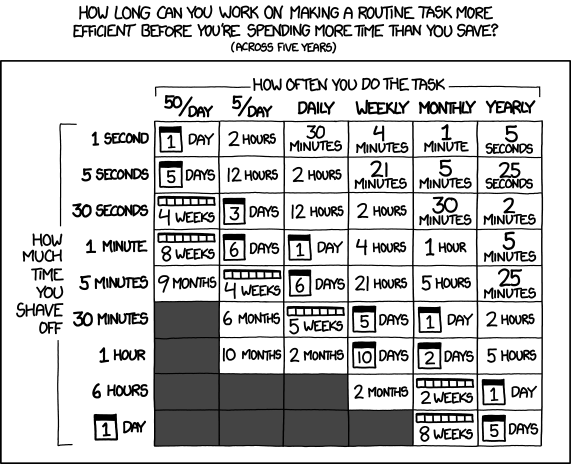
Your average junior to mid-level programmer will spend a ton of time automating things which could be done via brute-force. This is the classic trap of spending more time building automation than it would have taken to do it by hand. Building the skills to be able to estimate this takes a whole career, honestly. Knowing that you need to do this, though, is something that you can give to one another: simply print out the comic below and show people how to read it.

For example, I read this chart and know that every time I visit someone with multiple monitors, I need to tell them how to use the Window+Shift+Arrow shortcut. Why? Because your average person with multiple monitors will generally spend about 5 seconds 1) restoring an application window, 2) dragging it over to the other monitor, 3) maximizing the window … and they’ll do that at least 5 times per day. When you read those values into the comic above (5/day on the top axis, 5 seconds on the left axis) you get 12 hours spent in that activity over 5 years. In other words: every person I teach this trick will save 12 hours of labor over 5 years. That starts to be some real savings for the whole company, it takes me nearly no time at all, and it makes people really happy to learn as well!

This can also be useful for deciding whether to do projects, and help in deciding the importance of those projects (for example, if one person in your organization spends a day a month doing something that could be automated, that’s 8 weeks of savings over 5 years if you can automate it). That’s a whole other discussion, though it’s the same skill: so, maybe learn that skill, because making those kinds of decisions are important in moving into decision-making roles.

The other thing I tell junior developers in this talk is usually to get over the idea that there’s a perfect tool for things; the perfect tool is the one that gets the job done, and it may be that it’s clunky and kludgy but that doesn’t matter. I give the example here of how I use Excel to load data (I use Excel formulas to build SQL strings), or how I use Excel formulas to write C# code (I wrote some VBA code behind Excel & wrote some SQL code to feed data into Excel, which I’ve used to generate literally hundreds of thousands of lines of repetitive C# code), or how I use Excel formulas to write repetitive HTML (like, oh, a bunch of emails with different names & hyperlinks to their downloads). Even more importantly is the example of figuring out when to brute-force something (“Only 200 photos to crop? We’ll just use a photo editor rather than programming it. 40,000 photos to crop? Let’s write some Python and use CV2 to find the faces for us, so we can crop automatically.”)

There are plenty of examples to give, and plenty of tools that I use on a regular basis… but it basically comes down to using the same old set of tools because I know how to use them and because I’m efficient in using them. Yes, it would likely be faster for me to learn how to use RegEx … that is, if I knew RegEx way better than I do, I could be even more efficient than I am in Excel … but we come back to that chart and decide that it wouldn’t save me more than it would cost me. Likewise, if it’s only a few things & they can be hammered out using something simple, just spend the 20 minutes doing that rather than wasting more than that on building a tool for it.

Applying this kind of thinking to your own coding practice and knowledge acquisition is when you reach mastery: when you can look at a tool or language, determine how long it would take to master, determine how much time it would save you in the tasks you regularly perform, and decide whether or not to invest in learning it. That calculation is something which truly proficient programmers make on an intuitive basis, and which contributes to them sticking to the same things that have worked previously. If you’re conscious and intentional about it, though, it will lead you to some better decisions than, “oh, this is showing up on Hacker News, I should learn it!” That’s not to say that you shouldn’t learn new things (I’m dabbling in Python and convolutional neural networks these days), but that you should be aware that there’s a trade-off and it’s perfectly logical to decide not to learn the cool new tool / language.

So. That’s my usual talk on how to be intelligently lazy.

-D

Reappearances, Disappearances

Occasionally we’ll go through our blog links and check on all of the people we’ve maybe not heard from in awhile. Some of them have disappeared in favor of The Face Hook (sorry you’ve succumbed, Ms. Nancy), some have simply dropped out and don’t have any presence any longer (we miss you Chef Paz). Some have returned to blogging, though (Haalo is back, after a 4 year hiatus!), and others have started taking pictures again.

Portland 010

Welcome back, to those returning, and we hope those who have left will stop by to tell us where they’ve gone.

-D & T

New Website Hosting

For all of you out there who read this in a feed reader, apologies if you’ve just seen a whole bunch of our posts reappear: we’ve changed our hosting provider and gotten a new URL ( hobbitsabroad.com ). For everybody else, you’ll likely not notice any change, as all of the content that was hosted on Sonic is now hosted on LaughingSquid, at the new URL (well – you’ll notice that the site loads a million times faster than the old one, which is why we switched).

Mull D 72

Enjoy these boats, for your troubles.

-D